Does your child snore as loudly as a freight train? Do they seem exhausted even after a full ten hours of sleep, or perhaps they’re struggling to stay focused at school? If you’ve been scouring the internet for answers, you might be surprised to find that the solution could be sitting right in your local pediatric dentist’s chair.
Wait—a dentist for a sleep problem? It sounds a bit like calling a plumber to fix your Wi-Fi, doesn’t it? But here is the reality: pediatric dentists are often the first line of defense in identifying and even helping to treat Obstructive Sleep Apnea (OSA) in children. Because they specialize in the growth and development of the mouth and jaws, they can spot the anatomical “red flags” that a standard physical might miss.
In this guide, we’ll dive into the data-backed role of pediatric dentists in managing sleep apnea, explore the latest treatments for 2026, and help you determine if your child needs a consultation.
The Growing Reality of Pediatric Sleep Apnea
Sleep apnea isn’t just an “old man’s disease.” Recent data from the Sleep Foundation (2025) and other health organizations show that pediatric sleep apnea is more common than many parents realize:
- Prevalence: Approximately 1% to 5% of all children in the United States suffer from obstructive sleep apnea.
- The Snoring Connection: While not all snorers have apnea, about 10% to 20% of children who snore habitually are eventually diagnosed with OSA.
- The Obesity Factor: Among children who meet the criteria for obesity, the prevalence of OSA jumps significantly, affecting up to 60% of this demographic.
- Underdiagnosis: Experts estimate that 80% to 90% of sleep apnea cases remain undiagnosed, often because symptoms are mistaken for ADHD or “growing pains.”
Can a Pediatric Dentist Actually “Treat” It?
The short answer is: Yes, but usually as part of a team. A pediatric dentist does not typically provide a medical diagnosis—that is the job of a sleep physician through a Polysomnography (Sleep Study). However, once a diagnosis is made, your dentist becomes a vital player in the treatment plan. According to the American Academy of Pediatric Dentistry (AAPD), dentists are uniquely positioned to screen for and manage sleep-disordered breathing by monitoring and managing the developing craniofacial structure.
Screening and Early Detection
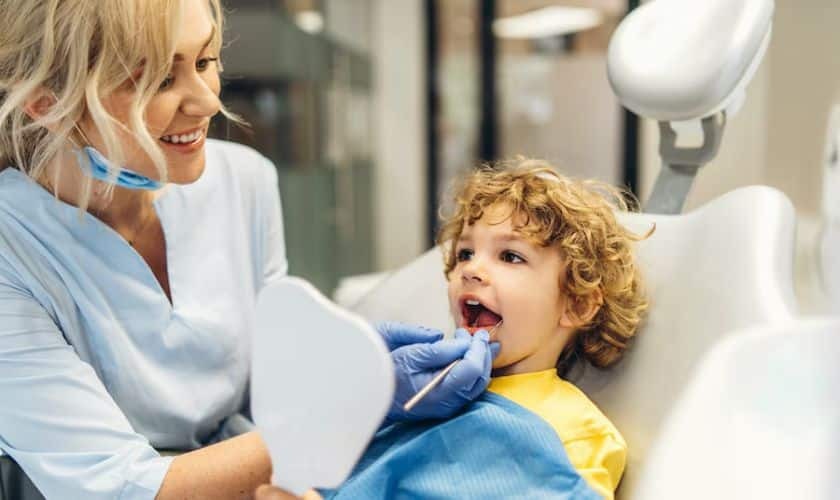
Your dentist sees your child’s mouth more often and more closely than almost any other healthcare provider. During a routine exam, they look for:
- Enlarged Tonsils and Adenoids: The #1 cause of pediatric OSA.
- High, Narrow Palates: This can restrict the nasal airway.
- Retrognathia: A recessed lower jaw that can cause the tongue to collapse backward during sleep.
- Dental Wear: Tooth grinding (bruxism) in children is often a physical response to the body trying to reopen a blocked airway.
Orthodontic Interventions
For many children, the issue is structural. If the jaw is too narrow or the mouth is too small for the tongue, a dentist can use Rapid Maxillary Expansion (RME).
- How it works: A custom appliance gently widens the upper jaw.
- The Result: Studies published in Sleep Medicine have shown that RME can significantly reduce the Apnea-Hypopnea Index (AHI)—a measure of sleep apnea severity—by increasing the volume of the nasal cavity.
Oral Appliance Therapy (OAT)
While CPAP machines are the “gold standard” for adults, they can be difficult for children to tolerate. A pediatric dentist can fit your child for a Mandibular Advancement Device (MAD). These devices gently move the lower jaw forward during sleep, preventing the soft tissues from collapsing and keeping the airway open.
When to Talk to Your Dentist
If you notice these symptoms, it’s time to book an evaluation:
- Loud, habitual snoring (3 or more nights a week).
- Gasping or snorting sounds during sleep.
- Heavy sweating at night or restless tossing and turning.
- Chronic mouth breathing during the day or night.
- Behavioral issues (irritability, hyperactivity, or lack of focus) that mimic ADHD.
Important Note: Untreated sleep apnea can lead to long-term health issues, including cardiovascular strain, delayed growth, and cognitive impairment. In fact, one study found that children with OSA use 40% more healthcare resources than those without the condition.
Conclusion
A pediatric dentist in Puyallup is much more than a “cavity crusader.” They are experts in the growth of your child’s face and airway. While they work alongside pediatricians and sleep specialists, their ability to provide non-invasive structural solutions—such as palatal expansion or oral appliances—makes them an invaluable resource in combating sleep apnea.
If your child is struggling to get a good night’s rest, don’t wait. A simple dental screening could be the key to unlocking better sleep, better behavior, and a healthier future.
Frequently Asked Questions
- Can a dentist diagnose my child with sleep apnea?
No. While a dentist can identify physical signs and symptoms, a formal diagnosis must come from a medical doctor (such as a pediatric pulmonologist or sleep specialist) after a sleep study.
- Is a palatal expander painful for my child?
Most children adjust to an expander within a few days. While they may feel “pressure” when the device is adjusted, it is generally well-tolerated and far less invasive than surgery or long-term CPAP use.
- My child is only 4 years old. Is that too young for treatment?
Actually, the peak age for pediatric OSA is between 2 and 8 years old, often when the tonsils are the largest relative to the airway. Early intervention (sometimes as young as 3) can help guide jaw growth and prevent more severe issues later.
- Will my insurance cover dental treatment for sleep apnea?
Many medical insurance plans (not just dental) cover oral appliances or orthodontic expansion when deemed medically necessary to treat a diagnosed sleep disorder. Always check with your provider first.
- What if surgery (removing tonsils) didn’t fix the problem?
This is known as residual OSA, and it happens in about 19% to 49% of cases. In these instances, a pediatric dentist is often the next step to determine whether structural jaw alignment or myofunctional therapy is needed to complete the treatment.